When a tiny, spotted beetle ambles across your window in autumn, your brain probably does a happy double-take and thinks, “cute ladybug!” But hold up — that little dot could be an Asian lady beetle, a look-alike that plays by different rules.
At first glance they’re nearly twinsies, but once you learn the differences you’ll know which ones are garden friends and which ones are slightly problematic houseguests. This guide breaks it down so you can protect your plants, your home, and your chill.
This is your no-fluff playbook: how to tell the real ladybugs from the impostors, what each one actually does, and how to handle them without freaking out.
What Are Ladybugs?
Ladybugs (also called lady beetles or ladybird beetles) are tiny, round beetles in the family Coccinellidae — basically nature’s little pest-control squad.
The most common native species in North America used to be the nine-spotted ladybug, and gardeners have loved them for ages because they absolutely demolish aphids and other plant pests. Think of them as tiny, spotted ninjas that protect your garden.
They’re small — about 0.3 to 0.4 inches long — and have that familiar dome shape with red or orange wing covers and black spots. They’re not just cute: one ladybug can chow down on thousands of aphids over its life (yeah, thousands — nature’s tiny vacuum cleaners).
- Read Also: Naturally Tackling Pests: A Guide to Organic Whitefly Control
- Read Also: Battling Bugs: Whitefly vs. Aphid – Know the Difference
Understanding Asian Lady Beetles
Asian lady beetles — officially called Harmonia axyridis — are basically the overachievers of the beetle world… who don’t always know when to chill.
They’re originally from eastern Asia, and scientists brought them to North America in the early 1900s (and again in the 1980s) to help farmers fight crop pests. On paper? Genius move. They crush aphids like pros.
But here’s the twist. They’re really good at surviving. So good that they didn’t just stay on farms. They moved into cities, suburbs… and yeah, sometimes your living room.
While they’re awesome at pest control in fields, they can be aggressive and love sneaking into houses when the weather gets cold. That’s when people start realizing, “Wait… this is not the cute garden buddy I signed up for.”
Unlike many native ladybugs, Asian lady beetles adapted like champions to modern neighborhoods. Now they’re one of the most common lady beetles in North America — in some places, they even outnumber the native species. Nature is wild like that. You introduce one helper, and suddenly it’s running the block.
Key Physical Differences
Color Variations
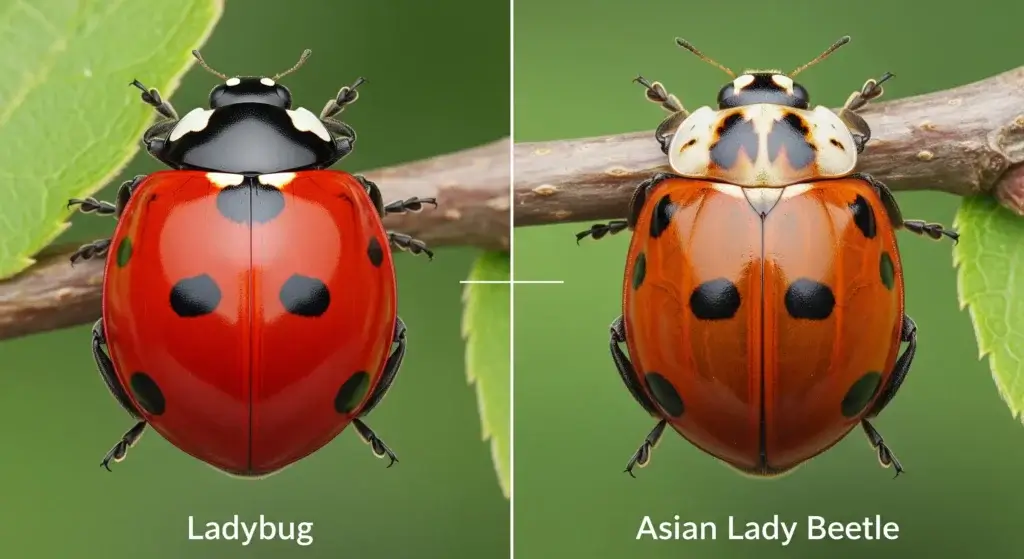
If you want to play beetle detective, start with color. Native ladybugs usually keep it classic: red or orange with neat black spots. Clean. Predictable. Iconic.
Asian lady beetles? Chaos energy. They come in pale yellow, orange, bright red — even deep red. Some have tons of spots. Some barely have any. Some look like they forgot to finish getting dressed. The variety can make them confusing, but that unpredictability is actually a clue.
The M-Shaped Marking
This is the big giveaway. Asian lady beetles usually have a black M-shaped (or sometimes W-shaped, depending on how you look at it) mark on the white area right behind their head. That white area is called the pronotum — fancy science word, but all it means is the shield-like plate behind the head.
If you see that little “M,” you’ve probably found your suspect. Most native ladybugs don’t have that marking. It’s like a tiny signature.
Size and Shape
Asian lady beetles are usually just a bit bigger — about 0.25 to 0.35 inches long. Not a massive difference, but enough that if you’ve seen both side by side, you might notice it.
They also look slightly more oval and a bit more domed. Native ladybugs tend to look rounder and more “button-like.” Asian lady beetles feel more stretched out — like someone gently pulled the sides.
Spot Patterns
Both types have spots, but here’s where it gets interesting. Native ladybugs usually stick to a consistent number. For example, the famous nine-spotted ladybug almost always has nine spots. Reliable. Predictable.
Asian lady beetles? They can have anywhere from zero to nineteen spots. Zero. Nineteen. That’s a huge range. Even beetles from the same group can look totally different. It’s like they’re all wearing slightly different outfits to the same party.
Behavioral Differences That Matter
Home Invasion Tendencies
Think of native ladybugs as chill roommates who crash under leaves and hang out behind tree bark during winter. They usually stay outdoors — no drama, no doorbell ringing at 2 a.m. Asian lady beetles, though, are the pushy couch-surfers of the insect world.
When the air gets crisp in autumn, they swarm the sunny sides of houses looking for tiny cracks to sneak through. Once they get inside, they’ll pile into attics, wall voids, and other warm hideouts by the hundreds — sometimes thousands. If your house had a group chat, these beetles would spam it nonstop.
Aggression and Biting
Most native ladybugs are lazy about biting people — they’d rather eat aphids than bother you. Asian lady beetles, however, will defend themselves if you disturb them. Their little mandibles can give a tiny pinch that stings more than hurts.
For most people it’s just a weird tickle or a red spot, but if your skin is sensitive you might notice some irritation. Not dangerous, just annoying — kind of like getting poked by a tiny, polite ninja.
Reflex Bleeding
Here’s a gross-but-fascinating trick: when threatened, Asian lady beetles can ooze a yellow, nasty-smelling fluid from their leg joints called hemolymph. It smells bad and can stain clothes, walls, or curtains.
Native ladybugs can do this too, but Asian beetles are way more dramatic about it and release more of the stuff. So if you find yellow stains or a funky odor after crushing one (please don’t make a habit of crushing bugs), reflex bleeding is probably the culprit.
Seasonal Activity Patterns
Both types are helpful during spring and summer, munching on aphids and protecting plants. But in the fall the Asian ones become impossible to ignore — they stop being “garden helpers” and start being “house squatters” as they search for places to overwinter.
That seasonal migration is when homeowners start freaking out, because one minute your windows are peaceful and the next they’re dotted with crunchy invaders.
Environmental and Ecological Impact
Competition with Native Species
Asian lady beetles are basically the overachievers that bully the other kids on the playground. They reproduce faster, eat a lot, and can outcompete native ladybugs for food and homes.
Scientists have watched native populations decline in places where the Asian beetles moved in — the nine-spotted ladybug, which used to be common, has become rare in a bunch of areas.
It’s a classic invasive-species domino effect: introduce a performer to help with pests, and suddenly the whole local ecosystem gets offbeat.
Agricultural Benefits vs. Residential Problems
Farmers actually love Asian lady beetles because they eat tons of aphids, scale insects, and other pests that trash crops.
So agriculturally they’re useful — like a hired pest-control squad. But that same talent turns into a problem when they swarm houses in autumn. In farms they’re heroes; in neighborhoods they become a real headache.
Impact on Wine Production
This one’s wild: in grape-growing regions, these beetles can ruin the vibe for winemakers. When Asian lady beetles get picked with grapes and smashed during wine-making, their reflex bleeding can leach into the juice and give the wine a weird, bitter, or “off” flavor — winemakers call it “ladybug taint.”
Because of that, vineyards have had to change how they manage fields and harvest grapes to avoid contaminating wine. So yeah — tiny beetles, big consequences.
Prevention and Management Strategies
Sealing Entry Points
The most effective long-term strategy for preventing Asian lady beetle infestations involves sealing potential entry points before autumn arrives. Focus on these key areas:
- Inspect and seal cracks around windows, doors, and foundations
- Install or repair window screens and door sweeps
- Fill gaps around utility lines, pipes, and cables entering your home
- Repair damaged siding, fascia, and soffit areas
- Install chimney caps and vent covers
Outdoor Lighting Considerations
Asian lady beetles are attracted to light, particularly during their autumn congregation period. Consider these lighting modifications:
- Switch to yellow or sodium vapor light bulbs, which are less attractive to insects
- Install motion-sensor lights instead of leaving exterior lights on continuously
- Keep curtains and blinds closed during peak activity periods
- Move outdoor lighting away from doors and windows when possible
Physical Removal Methods
If Asian lady beetles enter your home, physical removal is often the safest and most practical approach:
- Use a vacuum cleaner with a disposable bag to collect beetles
- Empty the vacuum bag immediately into an outdoor trash receptacle
- Avoid crushing beetles, which releases the staining defensive fluid
- Consider using a light trap designed for flying insects
Professional Pest Control
For severe infestations, professional pest control services may be necessary. Licensed exterminators can apply appropriate treatments to exterior surfaces before beetles begin congregating.
However, chemical treatments inside the home are generally not recommended, as dead beetles can attract other pests and the chemicals may pose health risks.
Living with Both Species
Supporting Beneficial Insects
Both kinds help your garden, so don’t go nuclear. Do this instead:
- Plant lots of different flowers and herbs so helpful bugs have food and homes.
- Skip broad-spectrum pesticides — they wipe out the good guys too.
- Make an insect hotel or leave a pile of sticks away from the house as a winter hangout.
- Focus on keeping beetles out of the house (seal cracks) rather than trying to wipe them all out.
Educating Others
Tell your neighbors, your school gardening club, or whoever waters the community plants what’s what. When everyone seals windows, tweaks lights, and avoids spraying everything, the whole street sees fewer beetle invasions. Teamwork actually works here.
- Read Also: Protect Your Harvest! Identifying Specific Vegetable Pests
- Read Also: Wireworm Damage in Beetroot: A Complete Guide
Conclusion
Short version: native ladybugs = garden heroes; Asian lady beetles = useful on farms but messy and clingy at home. Learn a few ID tricks (like the M mark behind the head), seal up your house, dim or change outdoor lights, and gently shoo invaders out when they show up.
Do that, and you protect your plants without turning your yard into an empty bug museum — win-win.